
.png)
International collaboration data gathering for SDG
Ege University actively contributes to international processes for gathering and measuring data related to the Sustainable Development Goals. The university participates in global networks that monitor sustainability indicators, provides institutional data to internationally recognized university ranking systems, generates scientific datasets through multilateral research projects in areas such as climate, environment and socio-economic development, and reports sustainability performance to global evaluation frameworks.
Selected examples within this scope are presented below.
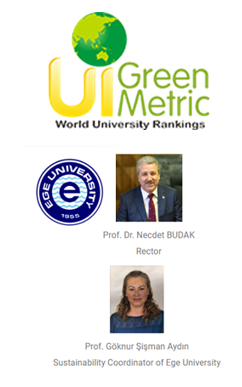
Ege University, whose remarkable achievements in the GreenMetric rankings since 2014 have both raised environmental awareness and built sustainable campuses, was appointed as a National Coordinator by the UI GreenMetric’s executive body, in 2024. Furthermore, Ege University is also the UI GreenMetric International Steering Committee, directly contributing to the development, improvement, and policy-level governance of the GreenMetric global sustainability gathering data and measurement framework, and participates in the process that discusses and approves the programmes of the network.
Source:
https://greenmetric.ui.ac.id/network/steering-committee
https://greenmetric.ui.ac.id/network/strategic-framework

Ege University has been an active member of the Sustainable
Development Solutions Network (UN SDSN) since 2014. Ege University, through its E.U. Sustainability Coordinatorship, continued to contribute to sustainability initiatives focused on the Sustainable Development Goals through 2024 by participating in annual member meetings within the UN SDSN framework.
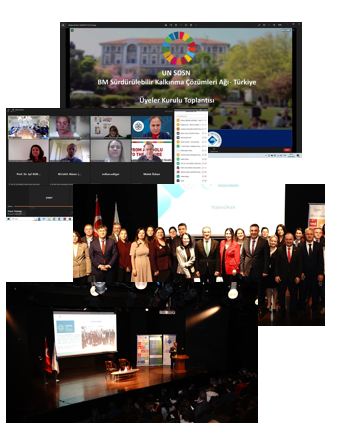
The 2024 Members’ Meeting, held together with the SDSN Türkiye 10th Anniversary Event, took place on 27 December 2024 under the auspices of Boğaziçi University. At the meeting, which was attended by rectors, vice rectors, SDSN Türkiye focal points from member universities, as well as representatives from the public sector, private sector, and civil society, the work of SDSN Türkiye member institutions was evaluated in light of COP29 and recent global developments. Ege University continues to contribute to multi-stakeholder dialogue on the Sustainable Development Goals at the national and international levels and to support policy discussions related to the 2030 Agenda.
.
https://surdurulebilir.ege.edu.tr/tr-18001/un_sdsn_turkiye_uyeler_kurulu_toplantisi.html
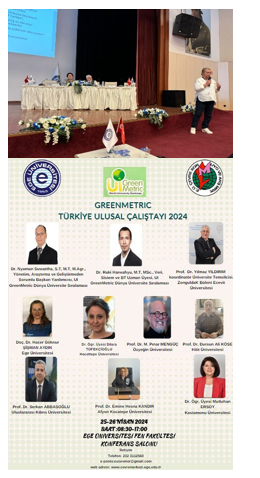
5th GreenMetric Türkiye National Workshop (25–26 April 2024)
In this context, Ege University hosted the 5th GreenMetric Türkiye National Workshop (25–26 April 2024), bringing together international GreenMetric leadership, sustainability directors, managers from environment/waste/energy departments, academics, and students. The workshop enabled exchange of best practices, co-learning, and collective action to advance SDG implementation at national level. The event, attended by the Vice-Chair of IU Greenmetric and his team, featured presentations from environmental, waste, and energy departments at various universities in Türkiye, sharing best practices from their respective institutions. At the end of the event, all university officials signed the IU Greenmetric Network Membership Declaration.
Source:
https://greenmetric.ui.ac.id/network/steering-committee
https://greenmetric.ui.ac.id/article/the-5th-national-workshop-on-ui-greenmetric-for-universities-in-turkiye
Since 2020, Ege University has actively contributed institutional datasets to internationally recognized university ranking systems, participating in global data-gathering and performance measurement frameworks that assess research, education, sustainability, and impact (https://siralamalar.ege.edu.tr)


Academic Ranking of World Universities (ARWU):

Center for World University Rankings (CWUR):

Round University Ranking (RUR):

University Rankin by Academic Performance (URAP):

University Assesments & Research Center (UNİAR):

Scimago Institutiıns Rankings (SCIMAGO):


Webometrics Ranking of World Universities (WEBOMETRİCS) :

UI GreenMetric World University Rankings
Ege University also participates in multiple international collaboration and innovation networks that facilitate global partnerships, expert exchange, and institutional engagement in cross-border initiatives.
Selected examples are listed below.
 Ege University is a member of the European University Association (EUA)
 Ege University is a member of ECHE
Erasmus+ is the EU's programme to support education, training, youth and sport in Europe

The European Energy Research Association, of which our university is a member, is the largest energy research community in Europe. The membership-based, not-for-profit association brings together 250 universities and public research centers in 30 countries. EERA's joint research programs cover all low-carbon technologies and systemic and collaborative issues.
Ege University is a member of the Enterprise Europe Network (EEN)
Enterprise Europe Network (EEN) is the world's largest collaboration network, serving SMEs, large companies, and researchers who want to establish international collaborations, with more than 600 member institutions and more than 3000 expert employees in more than 60 countries.
 Ege University is a member of the Association for Dental Education in Europe (ADEE)
 Ege University is a member of the Association of Universities for Textiles (AUTEX)

Ege University is a member of the Black Sea Universities Network (BSUN)
 Ege University is a member of the European Institute of Cultural Routes (EICR)
 Ege University is a member of the Turkic Universities Unıon (TÜRKÜNİB). Orhun Program is a student and faculty mobility program carried out among TÜRÜNİB member universities.
Through its leadership and/or participation in international research consortia, Ege University plays an active role in generating comparable datasets and in coordinated monitoring across multiple countries.
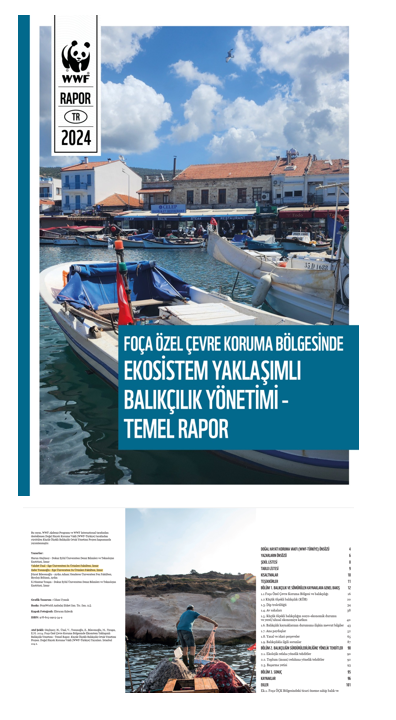
Ecosystem-Based Fisheries Management in the Foça Special Environmental Protection Area
Ege University academics strongly collaborate with international and national non-governmental organizations (NGOs) on research supporting sustainable marine management and biodiversity conservation. The Small-Scale Fisheries Co-Management Project collaborated with Ege University academics, led by the World Wide Fund for Nature (WWF-Türkiye), with the support of the WWF Mediterranean Programme and WWF International.
Within the scope of this project, researchers from the Ege University Faculty of Fisheries, Prof. Dr. Vahdet Ünal and Dr. Zafer Tosunoğlu, took part as project team members and co-authors of “Ecosystem-Based Fisheries Management in the Foça Special Environmental Protection Area- Main Report.” The project analyzes the ecological, social, and economic dimensions of small-scale fisheries, focusing on ecosystem-based management, the impacts of fishing on marine biodiversity, and sustainable policy recommendations for the Aegean region.
This collaboration demonstrates Ege University’s active participation in an internationally supported, NGO-led research project contributing to SDG 13 (Climate Action), SDG 14 (Life Below Water), and SDG 17 (Partnerships for the Goals).
Sustainable Soil Management for Climate-Smart Agriculture in Europe and Central Asia
Ege University actively contributes to the IAEA Technical Cooperation Project RER5028, titled “Sustainable Soil Management for Climate-Smart Agriculture in Europe and Central Asia,” implemented under the Agency’s thematic programme aligned with the Sustainable Development Goals. The project aims to monitor soil, water, and climate indicators using nuclear techniques across 32 participating countries. Through its involvement in research, data generation, and capacity-building activities within the project, Ege University supports the creation of comparable datasets and the development of sustainable agricultural practices.
https://www.iaea.org/projects/tc/rer5028


H2020 Project, CLIMOS Climate Monitoring and ,Decision Support Framework for Sand Fly-borne Diseases Detection and Mitigation
Composed of 29 partners, including Ege University, this project brings together researchers, practitioners, health institutions, technology platform designers, and at-risk communities to conduct innovative and applied research seeking to be better prepared for current and future impacts of climate and environmental changes on human and animal health, using sand flies and the multiple sand fly-borne diseases (SFBDs) that they transmit as a model system.

ValueFarm project, of which Ege University is a partner, focuses on valorizing Mediterranean small farms by introducing wild edible plants of the Mediterranean (WEPs) complementary crops within a competitive farming sector and a climate-changing world and cropping them in a sustainable point of view. Moreover, the contribution of WEPs cultivation to soil property improvement will be assessed by reducing or eradicating the use of agrochemicals, and by introducing the use of a more sustainable agriculture with biostimulants, biofertilizers and biopesticides and the use of tailored composts.
http://valuefarm-prima.agr.uth.gr/consortium/
 Ege University – NGO Strategic Collaboration on Climate Change Adaptation: Ege University-Society for Urban Ecology (SURE) partnership:
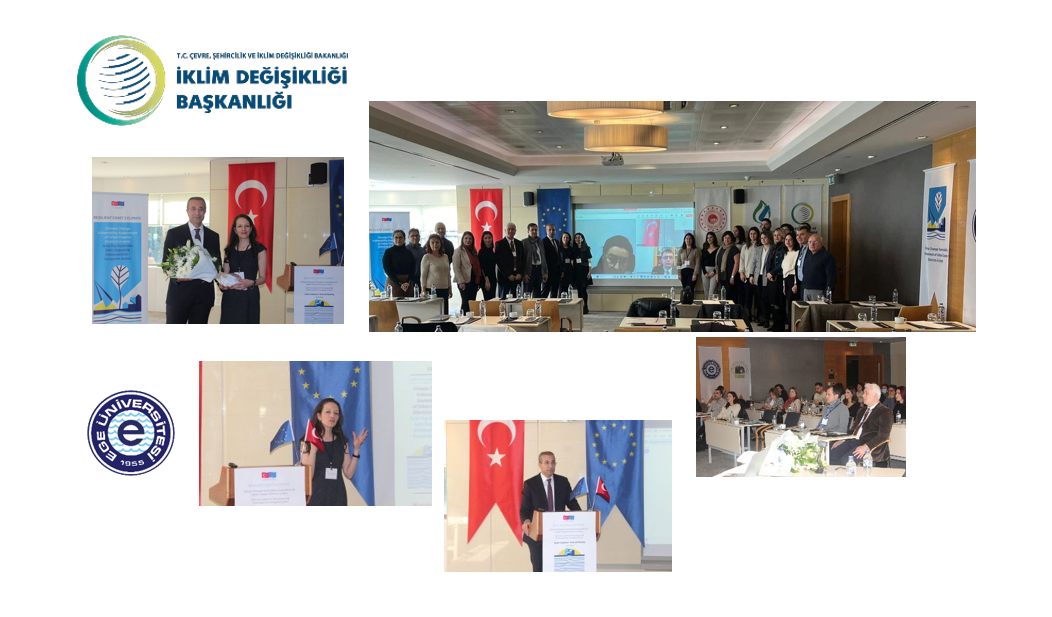
The “Climate Change Vulnerability Assessment of Urban Coastal Districts in Izmir” Project was led by Ege University (Faculty of Agriculture – Department of Landscape Architecture) in partnership with the Austria-based NGO Society for Urban Ecology (SURE). The project was supported within the scope of the “Grant Programme for Climate Change Adaptation”, as financed by the European Union and the Republic of Türkiye and realized by the United Nations Development Programme (UNDP), and was officially launched at Ege University on 22 January 2024.
The opening meeting was attended by Assoc. Prof. Dr. Abdulkadir Bektaş (Deputy Head of the Climate Change Presidency, Ministry of Environment, Urbanization and Climate Change), SURE representatives, Ege University academics, and the EU Delegation to Türkiye.
This transnational project enhances climate change adaptation capacity by combining scientific assessment, stakeholder engagement, and sectoral vulnerability analysis. Coastal districts of Izmir were assessed for major climate hazards (heatwaves, urban flooding, storm-surge coastal flooding), vulnerability hotspots were identified, and nature-based solutions (green infrastructure and ecosystem-based adaptation) were co-developed.
The consortium included academics from Türkiye and Romania, as well as an international NGO partner (SURE) from Austria. The project delivered capacity-building programs for local authorities, universities, municipalities, NGOs, and communities, and contributes to the EU Green Deal priorities and the Sendai Framework for Disaster Risk Reduction. The project will have been completed in June 2025.
Optimal Usage Of Natural Product And Biological Priming Agents To Improve Resilience Of Agrosystems To Climate Change
OPTIMUS PRIME aims to design, optimize and deliver a cost-efficient seed priming technology based on the combination of natural compounds and microorganisms to improve crop performance and productivity under adverse environmental conditions contributing to a sustainable agriculture.
https://sites.google.com/uji.es/optimus-prime-prima/home
URBAN GreenUP, of which Ege University is a partner, is a project financed within the scope of the European Union's Horizon 2020 program. It aims to develop, implement, and replicate Renewed Urban Plans in a number of European and non-European partner cities to reduce the effects of climate change, improve air quality and water management, and increase sustainability—cities with innovative nature-based solutions.
https://www.urbangreenup.eu/about/partners/
 Ege University, Assoc. Prof. Dr. İnci Tüney Kızılkaya, in collaboration with the Mediterranean Conservation Society, analyses the impact of climate change on marine ecosystems and living life in detail. In this context, the project team carries out studies on the potential effects of climate change on marine biodiversity, strategic planning on the importance of protecting marine areas and developing sustainability recommendations.
Gökova Bay to Cape Gelidonya Turkey Project
Restoring marine ecosystem connectivity in south western Turkey. This project is removing barriers to the recovery of marine ecosystem from Gökova Bay to Cape Gelidonya, triggering the revival of healthy ecosystem processes. A fully functioning ecosystem which keeps invasive species in check will generate sustainable benefits for local people and increase resilience to climate change. https://www.endangeredlandscapes.org/project/gokova-bay-to-cape-gelidonya/
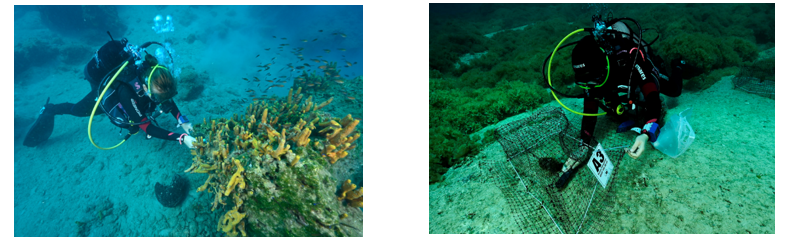
Gökova Gulf – Sponge Monitoring Marine ecosystem restoration experiments